English
 Deutsch
 español
 français
 العربية


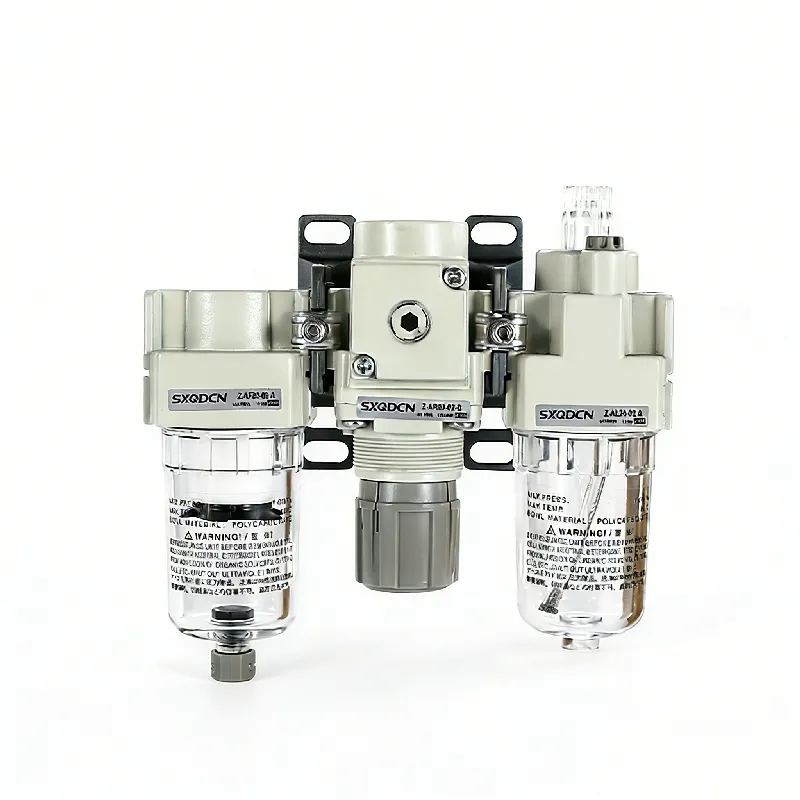
The Air Preparation Unit, commonly known as the "FRL" (Filter, Regulator, Lubricator) or "Pneumatic Trio," is the cornerstone of any reliable pneumatic system. It ensures clean, stable, and lubricated air, protecting downstream components and guaranteeing optimal performance.
Classification by Core Function & Standard Usage:
A standard FRL combines three essential functions in sequence:
- Filter (F)
Function & Type: The first line of defense. It removes liquid water, oil aerosols, and solid particulates (rust, pipe scale) from compressed air. General Purpose Filters (5 to 40 microns) are most common. For finer protection, Coalescing Filters (0.01 to 1 micron) are used.
Standard Operating Procedure:
Installation: Install strictly according to the flow direction arrow marked on the housing (Inlet → Outlet). Incorrect installation renders it ineffective.
Daily Maintenance: Manually drain accumulated liquids by operating the manual drain valve (push or twist) at the bowl bottom. If equipped with an auto-drain, ensure it functions periodically.
Scheduled Maintenance: Replace the filter element based on the differential pressure indicator (if available) or on a scheduled basis (typically every 6-12 months).
- Pressure Regulator (R)
Function & Type: Reduces and stabilizes fluctuating inlet pressure to a constant, preset working pressure. General-Purpose Relieving Regulators are standard; they vent excess downstream pressure to atmosphere when adjusted lower. Precision Regulators offer tighter control for sensitive equipment.
Standard Operating Procedure:
Pressure Setting: Pull up the adjustment knob to unlock. Turn clockwise to increase, counter-clockwise to decrease pressure while observing the output gauge. Push and lock the knob down after setting to prevent accidental shifts.
Sizing: Ensure the regulator's flow capacity (Cv or Kv value) meets the total downstream demand to avoid excessive pressure drop during operation.
- Lubricator (L)
Function & Type: Introduces a fine oil mist (aerosol) into the air stream to lubricate moving parts in valves, cylinders, and tools. Micron-fog Lubricators generate a very fine mist for long-distance travel in pipes. Oil-Fog Lubricators produce larger droplets for immediate, local lubrication.
Standard Operating Procedure:
Filling: ALWAYS depressurize the system first. Unscrew the bowl and fill with ISO VG32 or equivalent pneumatic tool oil to between the MIN and MAX marks.
Adjustment: With the system operating, adjust the metering valve (usually on top) to achieve 1-3 drops per minute in the sight glass. Increase during initial start-up or heavy use.
Critical Note: Omit the lubricator (use only an FR unit) for applications requiring oil-free air (e.g., food, pharmaceuticals, packaging) or when using pre-lubricated or oil-free components.
Standard System Startup Sequence:
Install: Mount vertically (for proper drainage/lubrication) in the sequence: Air Source → Filter → Regulator → Lubricator → Equipment.
Charge: Slowly open the main air supply valve.
Drain: Manually drain the filter.
Set Pressure: Adjust and lock the regulator to the required tool/cylinder pressure.
Adjust Lubrication: Set the oil drip rate with the system cycling.
Shutdown: Close the supply and exhaust system pressure.